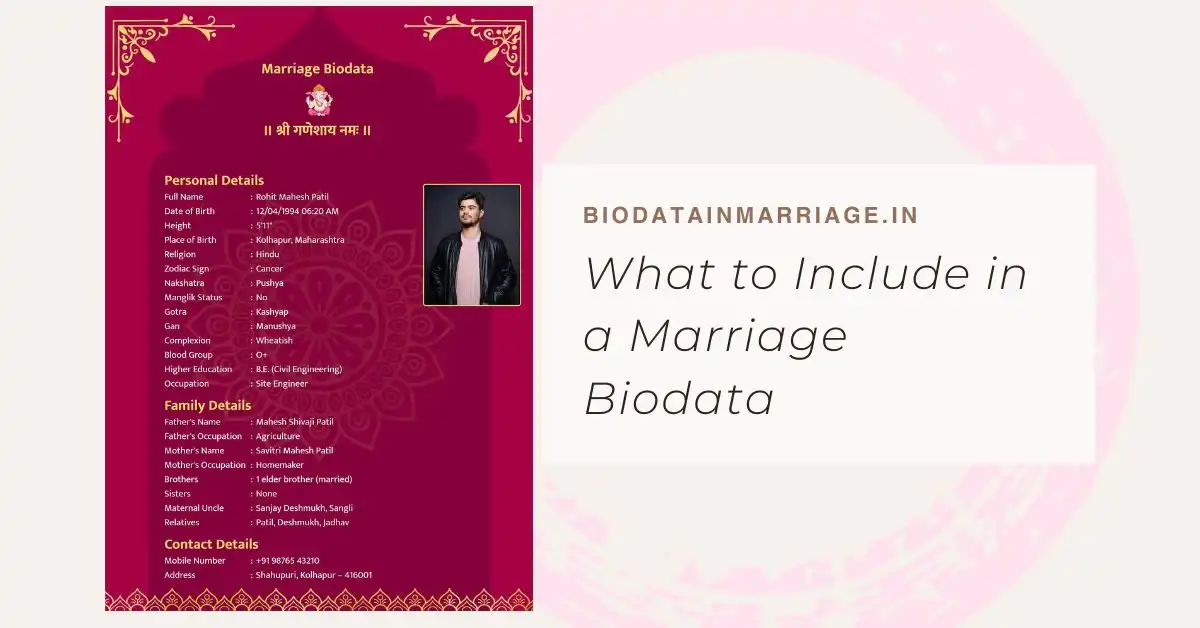
In this guide: A comprehensive, section-by-section breakdown of what exactly should go into your marriage biodata. Stop guessing and use this checklist to build a complete profile.
What to Include in a Marriage Biodata: The Ultimate Checklist
Crafting a marriage biodata requires a delicate balance. If you provide too little information, families will ignore your profile or constantly ask follow-up questions. If you write an overwhelming essay, the reader will lose interest. Knowing exactly what to include in your marriage biodata ensures you strike the right balance, providing clarity without crossing into over-sharing.
1. Personal Information
This is the foundation of your profile. Keep these details sharp, accurate, and near the very top of the document. Most families scan this section first before reading further.
- Full Name: Clearly stated.
- Age & Date of Birth: Write the full date (e.g., 14th August 1995).
- Physical Attributes: Height is mandatory. Weight and blood group are optional but highly appreciated in traditional circles.
- Current Location: Where are you currently living and working?
- Marital Status: Never married, divorced, or widowed. Be totally transparent here.
2. Religious & Astrological Details
In many Indian and South Asian communities, horoscope matching is a non-negotiable step before families even meet. If this applies to you, skipping this section will only delay the process.
- Religion & Caste: Specify the exact sub-caste if applicable.
- Gotra / Sect: This is crucial for avoiding same-lineage marriages globally.
- Time & Place of Birth: Required for accurate astrological charts.
- Mangalik Status / Dosha: It is always better to state this upfront if you know it.
3. Professional & Educational Background
Your academic and career trajectory demonstrates stability and ambition. Be specific here, as generalized statements like "Working in IT" are not particularly helpful.
- Highest Education: Mention your degree and optionally the university (e.g., MBA from IIM Ahmedabad).
- Current Profession: Your exact job title (e.g., Senior Software Engineer).
- Organization: The name of the company you work for.
- Income: Mentioning your annual package is becoming increasingly standard. It filters out mismatched expectations quickly.
4. Family Background
Marriage is often viewed as the union of two families, not just two individuals. Families want to know the socio-economic and cultural background of the household you grew up in.
- Father's Name & Occupation: E.g., Mr. Raj Sharma, Retired Bank Manager.
- Mother's Name & Occupation: E.g., Mrs. Anita Sharma, Homemaker.
- Siblings: How many brothers and sisters do you have? Are they married? Briefly mention their professions.
- Native Place / Ancestral Town: Where are your family's roots?
5. The "About Yourself" Section
Do not skip this. The factual data above could belong to thousands of people. The "About Me" section is where your unique personality shines. Mention what a typical weekend looks like for you, your hobbies (like reading, fitness, or traveling), and your core values. Be honest. If you are deeply introverted, it's perfectly fine to say you enjoy quiet evenings over large parties.
6. Partner Expectations
Briefly outline what you are looking for in a spouse. Keep it broad enough to not sound demanding, but specific enough to weed out obvious incompatibilities. Focus on values, career support, lifestyle habits (like smoking/drinking preferences), and willingness to relocate.
If you want to view real-world examples of how these sections are strung together, you can browse through our marriage biodata examples and samples.
Let Us Do the Formatting For You
Now that you know what to include, use our builder to automatically arrange all these details beautifully.
Start Your Biodata NowFrequently Asked Questions
Should I include my contact details on the biodata itself?
Absolutely. A biodata should always conclude with the primary contact number and email address. Clearly state whether the number belongs to you or your parents.
Is it a bad idea to omit my salary?
It's a personal choice. Omitting it completely is fine if you are uncomfortable sharing that document widely. However, expect families to ask for a ballpark figure over the first phone call.